Writing your own last will and testament means understanding what a proper template actually contains – not just filling in blanks at random.
This article breaks down every clause a last will and testament template should include, from the opening declaration to the signing and witnessing block. Each section explains what the clause does and shows example wording.
Whether you use a free template, a paid version, or a guided generator, the structure stays the same. Get that right, and the rest is simply filling in your details.
Table of Contents
- What Is a Last Will and Testament Template?
- Core Structure of a Last Will and Testament Template
- Template Heading and Testator Details
- Revocation of Previous Wills and Codicils
- Age and Mental Capacity Declarations
- Appointment of Executors in the Template
- Guardianship and Dependent Care Clauses
- Specific Gifts and Other Beneficiaries
- The Residual Estate (Residuary Clause)
- Funeral Wishes and Personal Requests
- Signing, Witnesses, and Making the Template Legally Binding
- Using and Customising a Free Last Will Template
- Paid Templates vs Guided Online Will Generators
- Storing, Reviewing, and Updating Your Completed Will Template
- Key Takeaways
- FAQ
- Can married couples use a single last will and testament template together?
- Do I need a solicitor if I use a last will and testament template?
- How often should I replace an old will made from a template?
- Can I add my own clauses to a free last will template?
- What happens if I forget to include an asset in my will?
What Is a Last Will and Testament Template?
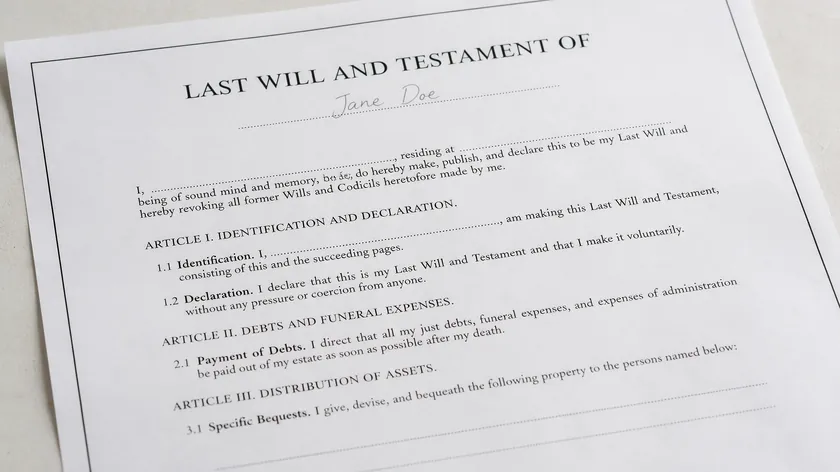
A last will and testament template is a pre-structured legal document with standard clauses and blank spaces you fill in to create your own last will. It uses recognised UK legal wording and leaves room for your names, dates, addresses, specific gifts, and other beneficiaries.
The template is designed to become a legally binding will once you complete it, sign it, and have it witnessed properly. It is not an internal checklist or a planning worksheet – it is the actual document your executors and the probate service will rely on.
A last will and testament outlines asset distribution after death, and a well-built will template makes sure every important instruction is captured in a single legal document. Despite this, 53% of adults aged 50–64 still lack a will, which means their estate passes under intestacy laws instead of their own wishes.
A will minimises disputes among surviving family members and ensures your testator’s wishes are honoured.
You will find will templates in several formats – blank PDF or Word downloads, interactive online forms, and solicitor-drafted documents. This guide focuses on the first two, since they are the most accessible starting points for the person making their own last will.
Core Structure of a Last Will and Testament Template
Think of this section as a roadmap. A modern last will and testament template in the UK follows a consistent sequence, and each part becomes a numbered clause in the finished document so it is easy to follow for executors and the probate court.
The standard sections appear in this order:
- Title and introductory declaration
- Revocation of previous wills and codicils
- Age and mental capacity declarations
- Appointment of executors
- Guardianship for minor children
- Specific gifts
- Residual estate clause
- Funeral wishes
- Signing and witnessing block
Key components of a will include the identification clause and the appointment of executors, but every section above plays a role in making the document complete. The sections below explain how to fill each clause correctly, with examples for single people, married couples, and blended families.
Template Heading and Testator Details
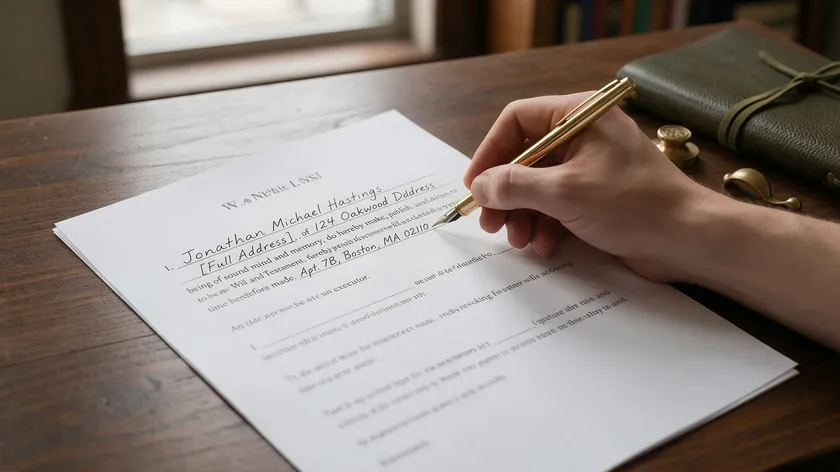
The template should start with a clear title – for example, “Last Will and Testament of John Michael Smith” – centred at the top of the first page. This preliminary declarations section identifies exactly who is making the will.
Below the title comes an opening declaration paragraph. It states your full legal name, address set out in full, and an explicit statement that this is your last will and testament. Example wording:
“I, JOHN MICHAEL SMITH of 14 High Street, York, YO1 7AB, born on 12 March 1975, declare this to be my Last Will and Testament.”
The template should allow you to record your marital status – single, married, civil partner, divorced, or widowed – and the country within the UK where you are based.
This matters because legal requirements for a valid will vary by jurisdiction, and your marital status can affect how parts of the will are interpreted.
Accurate identification also reduces the risk of confusion with people who share a similar name or address. Use your full legal name, not a nickname.
Revocation of Previous Wills and Codicils
A new will should normally revoke all previous wills and codicils to prevent conflict or partial revocation. The template includes a standard revocation clause, for example:
“I revoke all previous wills and testamentary dispositions made by me.”
This clause matters if you have ever made informal wills, mirror wills with an ex-partner, or older DIY wills that no longer reflect your wishes.
Without it, earlier documents could compete with your latest instructions, creating confusion for executors and family members.
Do not delete the revocation clause unless you have taken specific legal advice about keeping an earlier document in force. Most templates include it as a non-optional opening clause for good reason.
Age and Mental Capacity Declarations
Under UK law, the testator must be of legal age to make a will – 18 or over in England, Wales, and Northern Ireland. The will must also reflect the testator’s true intentions, which requires mental capacity at the time of signing.
A template can include a simple confirmation, for example:
“I declare that I am over 18 years of age and of sound mind.”
This statement does not replace medical evidence, but it supports the will’s validity if someone later questions mental capacity.
The legal test for capacity comes from the Banks v Goodfellow (1870) standard – the testator must understand what the will does, recall the extent of their assets, and recognise who might reasonably claim on their estate.
Witnesses usually observe the testator’s mental capacity and freedom from undue influence when they sign. If there is any doubt about capacity, a medical opinion obtained at the time of signing strengthens the document considerably.
Appointment of Executors in the Template
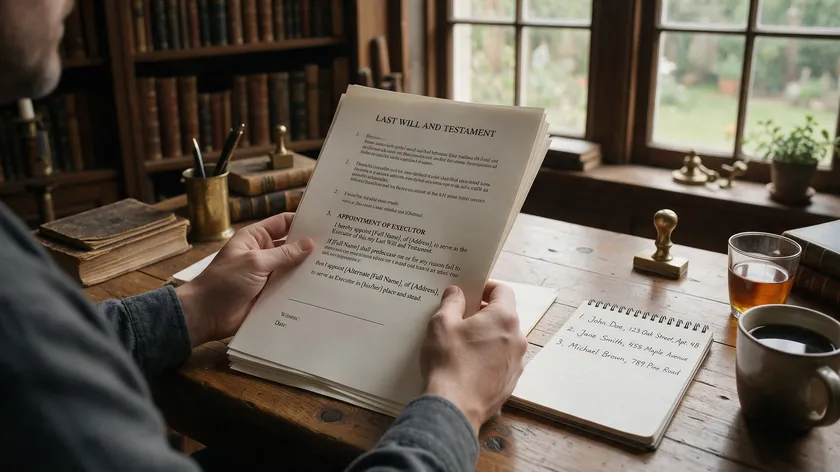
A will must name an executor to manage the estate. Executors are the people – sometimes called your personal representative – who carry out the instructions in the last will.
They deal with banks, close bank accounts, sell real property belonging to the estate, settle legally enforceable debts and funeral expenses, and distribute what remains to all the beneficiaries.
The template provides lines for one or more executors’ full names, addresses, and their relationship to you. You can appoint up to four executors in your will. Example wording:
“I appoint my sister, SARAH JANE BROWN of 22 Oak Road, Leeds LS3 1AB, to be my Executor.”
A good template also allows for substitute executors – backup choices if your first pick dies before you or is unable to act. The powers granted to executors under a basic template are usually standard, but a complex estate plan might need bespoke executor powers drafted by a solicitor.
This section should stay relatively consistent across free and paid templates. The important thing is clear instructions – full names, current addresses, and a defined order of appointment.
Guardianship and Dependent Care Clauses
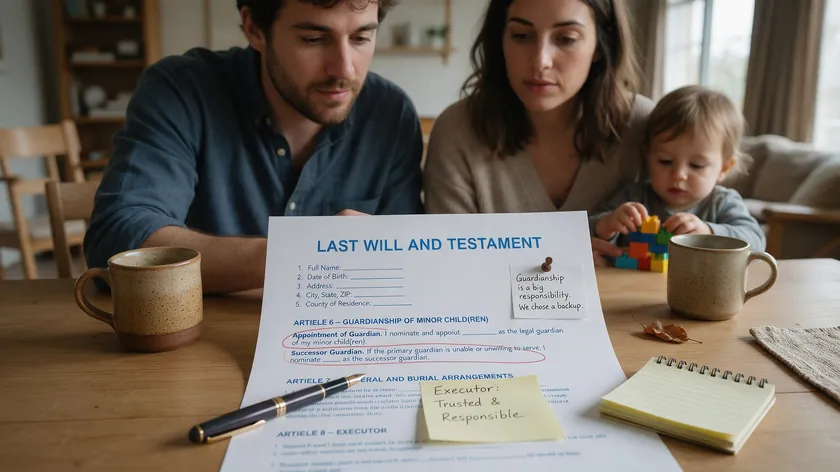
Your will can include guardianship instructions for minor children or other dependants who need care. Templates usually include an optional guardianship clause where you can appoint guardians and name primary and reserve choices.
Use full names and addresses to avoid ambiguity. Guardians for minor children should be named in the will so that your wishes are recorded formally. Example wording:
“If my spouse does not survive me, I appoint EMMA LOUISE CLARK to be guardian of any of my living children under 18.”
Marital status and parental responsibility both affect who has the legal right to care for children if a parent dies. A guardianship clause does not override existing parental responsibility held by a surviving parent, but it does carry significant weight in court if disputes arise.
This section is optional in most templates. If you have no minor children or dependants, you can skip it entirely.
Specific Gifts and Other Beneficiaries
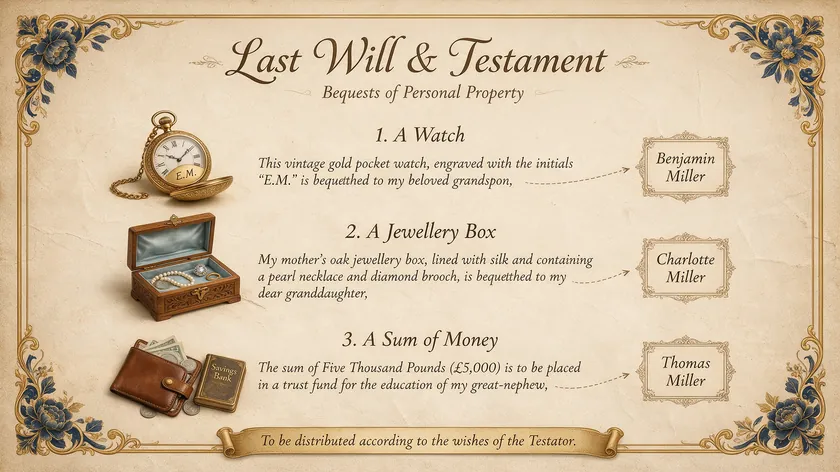
This is the part of the template where you list specific gifts – sums of money, personal items, real property, or particular possessions – before the residue is dealt with. A will can specify gifts of money or possessions to individuals, and this clause is where those details live.
The template should provide repeated blocks for each gift. For every entry you fill in: a description of the gift, such beneficiary’s full name, and a contingency if the beneficiary dies before you. Examples:
- “£5,000 to my niece, LUCY KATE WILLIAMS”
- “My Omega watch to my friend, DAVID JOHNSON”
Beneficiaries are individuals who inherit from the will, and they should be identified precisely. Avoid informal descriptions – writing “my car” without a registration number or make/model can cause disputes. Where possible, include enough detail to identify the item beyond doubt.
Wills can include provisions for digital assets and personal effects in this section as well. You can leave gifts of personal property such as jewellery, furniture, or even online accounts with clear instructions for access.
Specific gifts are taken from the estate before the residual estate is calculated, which can affect what other beneficiaries receive. If you leave too many large specific gifts, the residue may shrink considerably – so plan your share allocations carefully.
The Residual Estate (Residuary Clause)
The residual estate clause tells executors what to do with “everything else” left after debts, taxes, and specific gifts. This is often the most important clause in a last will because most assets – bank accounts, savings, real property, investments – typically fall under it.
A good template offers different options for estate distribution: leaving the residue to one person, splitting it into percentages among multiple beneficiaries, or naming charity beneficiaries. Example:
“I give the residue of my estate in equal shares to my children, AMY JONES and THOMAS JONES, who survive me by 30 days.”
That 30-day survival condition prevents the estate passes through a beneficiary who dies shortly after you. The template should also prompt you to add gift-over provisions – backup beneficiaries if the main ones die first. Without a gift-over, such share might lapse entirely.
Without a will, your estate follows intestacy laws – and unmarried partners inherit nothing without a will. Your estate may even go to the Crown if no relatives exist. A clear residuary clause avoids all of this.
This clause is where married couples often mirror each other’s wills, each leaving everything to the spouse and then divided equally among children. But each person still signs a separate document – joint wills are rare and problematic under UK law.
Funeral Wishes and Personal Requests
Funeral wishes are usually not legally binding, but including them in the template guides family members and executors at a stressful time. The template can offer options for burial or cremation preference, location of service, and any religious or cultural wishes.
You can also leave a space for brief personal messages or instructions about funeral arrangements. These are secondary to the main legal clauses, but they provide comfort and clarity.
One important reminder – urgent funeral decisions are often made before the will is read. If you have strong preferences about your funeral, share those wishes with your family during your lifetime as well.
Signing, Witnesses, and Making the Template Legally Binding
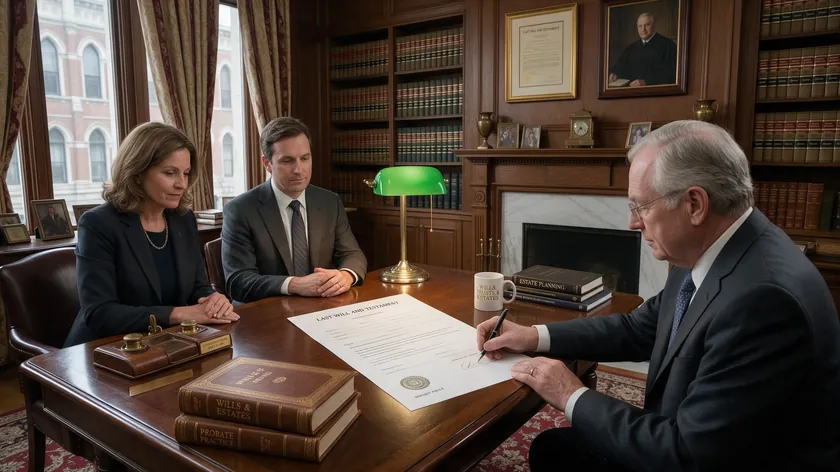
Without correct signing and witnessing, a carefully drafted will template may not be legally binding. Wills must comply with the Wills Act 1837 in England and Wales, and a valid will must be in writing and signed by the testator.
The signing block
The template ends with a clear signing block containing: the testator’s signature line, printed name, date, and address. The testator declared their intentions by signing, and the above written date confirms when the document was executed.
A will must be signed by the testator and two witnesses. The signature I line should be clearly labelled, and the testator should sign on or near the preceding pages to connect all parts of the document. The written date must be accurate – it establishes which will is the most recent.
The witness area
Below the testator’s block, two independent adults – the witnesses hereto – each have separate lines for their true signature, printed names, addresses, and the date.
Two independent witnesses must sign the will, and they must not be beneficiaries or the spouse or civil partner of any beneficiary. If a contesting beneficiary or any beneficiary acts as a witness, the gift to them may be void.
Wills must be signed in front of two independent witnesses who are present at the same time. Typical witness wording reads:
“Signed by the above-named testator in our presence, and then by us in the presence of the testator and of each other.”
Rules can vary slightly within the UK. For example, video witnessing was permitted in England and Wales under specific legislation, requiring a clear line of sight in real time. Always follow current local guidance to make sure your last will is legally valid and legally enforceable.
Using and Customising a Free Last Will Template
A simple free last will template can work well for straightforward estates. For example, a single person without children leaving everything to siblings, or married couples leaving everything to each other and then to adult children, can usually manage with a basic template.
Many templates can be completed in about 5 minutes for these simple scenarios, and templates include guidance notes for editing and signing.
Typical limitations of a generic free template include:
- Fewer options for trusts created for vulnerable beneficiaries
- No clauses for business assets or overseas property
- Limited support for blended families or complex family situations
- No built-in contest provision or wipeout provision
Avoid editing or deleting core legal phrases unless you understand the consequences. If a template uses plain English wording that you do not fully understand, check the guidance notes before removing anything. An official alteration to a signed will requires careful handling – never simply cross out and initial.
Print and review your completed draft slowly. Check every name, address, and percentage. Make sure all important assets – including real property, bank accounts, and personal property – are covered somewhere in the will, whether in the specific gifts section or the residuary clause.
After any major life events – marriage, divorce, or the birth of a child – either update the will via a codicil or create a new will using a fresh template.
Paid Templates vs Guided Online Will Generators

There are three broad approaches to creating your own last will: free downloadable templates, paid downloadable templates, and guided online generators.
You can create a will without a solicitor’s involvement using any of these methods, though it is advised to consult with a qualified estate planning attorney for complex estates.
| Feature | Free Template | Paid Template | Guided Online Generator |
|---|---|---|---|
| Typical cost | £0–£30 | £30–£100+ | £50–£350+ |
| Editing flexibility | Full manual control | More clause options | Structured Q&A output |
| Risk of legal error | Higher – no prompts | Moderate – some guidance | Lower – built-in checks |
| Automatic revocation clause | Sometimes missing | Usually included | Always included |
| Guidance and support | Minimal | Instructions included | Interactive, step-by-step |
| Time to complete | 5–20 minutes | 10–30 minutes | 10–20 minutes |
Cost data sourced from MoneyHelper.
Paid downloadable templates
Paid templates usually include more clauses – simple trust options, detailed general provisions for married couples, voting rights for trustees, and other provisions for liens attached to such property. They still rely on self-editing, so the risk of error sits with you.
Guided online will generators
A guided online generator works differently. You answer structured questions about your marital status, children, property, and other beneficiaries, and the system builds a tailored testament template automatically.
The benefits are clear – reduced drafting errors, consistent wording, automatic revocation of previous wills, and prompts for the residual estate and funeral wishes. The probate process runs more smoothly when the will follows a recognised structure with no missing clauses.
Our guided tool collects the same information this article explains – marital status, executors, beneficiaries, specific gifts, and funeral wishes – and generates a complete, ready-to-sign last will and testament template in the UK that covers every clause discussed above.
Storing, Reviewing, and Updating Your Completed Will Template
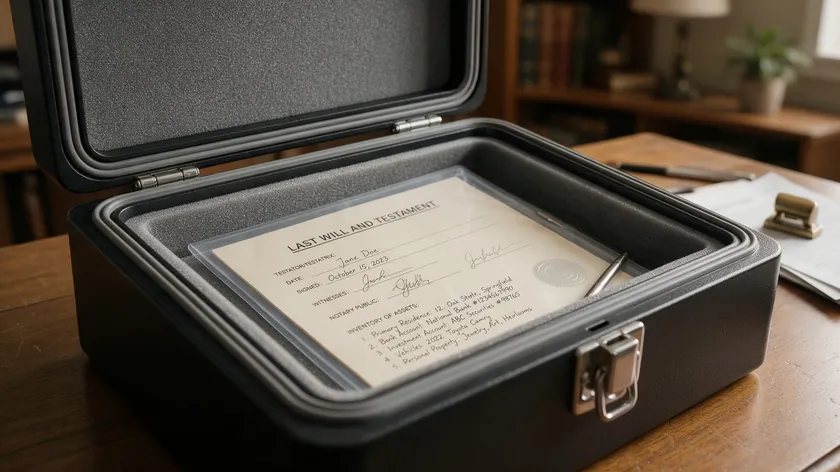
Once your last will and testament template is complete, three things matter most – storing it safely, reviewing it periodically, and updating it after major life events.
Storing your will
A printed, signed will should be stored in a safe but accessible place. Tell your executors exactly where the original is kept – whether that is a fireproof safe at home, a solicitor’s office, or a probate service storage facility. Without access to the original, the probate process can stall.
Reviewing your will
You should review your will every five years or after major life events. Key triggers include marriage, separation, divorce, the birth of a child, buying or selling property, and inheriting from others. Even if nothing has changed, a periodic review confirms that your estate plan still matches your intentions.
Updating your will
Many testators choose to destroy an outdated will and sign a new will using an updated template, rather than layering multiple codicils on top of each other. A new will should always include a revocation clause to cancel all previous wills.
Marriage or civil partnership can automatically revoke an earlier will in many cases under UK law, so a new will is essential after such changes.
Keep a simple list alongside the will showing major assets and contact details for advisers – it makes life easier for executors and speeds up estate distribution.
With your template structured and stored safely, you have everything you need to protect your family and honour your wishes. The FAQ below answers common questions readers have about using a will template.
Key Takeaways
- A last will and testament template is a structured, legally focused document you can customise clause by clause – it is not a vague worksheet or informal plan.
- A good template covers every essential section in order – revoking previous wills, naming executors, appointing guardians for minor children, listing specific gifts, distributing the residual estate, recording funeral wishes, and capturing legally valid signatures.
- Legal validity turns on both wording and formalities – the testator must be of legal age, have mental capacity, and sign in front of two suitable witnesses.
- The residual estate clause protects other beneficiaries and prevents assets from falling into intestacy by accident.
- Free last will templates suit simple estates, paid templates add useful clauses, and guided online generators reduce drafting errors by walking you through structured questions – choose the approach that matches the complexity of your estate.
Ready to turn this knowledge into a finished document? Use our last will and testament generator to answer clear questions about your marital status, executors, beneficiaries, and funeral wishes – and instantly generate a personalised, ready-to-sign last will and testament template.
FAQ
Can married couples use a single last will and testament template together?
UK law treats each person’s last will separately. Married couples should use the same style of template, but each spouse or partner signs their own document. “Mirror wills” use matching templates with reciprocal gifts – for example, each leaving everything to the other, then to children – but they are still two separate wills.
Joint wills, where both people sign one document, are rare and can cause complications. Standard templates do not usually support them, and most solicitors advise against them.
Do I need a solicitor if I use a last will and testament template?
A correctly completed, signed, and witnessed template can be legally binding without a solicitor, especially for simple estates. You can create a will without a solicitor’s involvement if your circumstances are straightforward.
However, professional advice is worth seeking where there are complex assets such as business interests or overseas property, vulnerable beneficiaries, or potential family disputes.
If you are unsure about particular clauses, a one-off solicitor review is far cheaper than the cost of a flawed will.
How often should I replace an old will made from a template?
Review the will every three to five years and after major changes such as marriage, divorce, the birth of a child, or significant shifts in wealth. For small tweaks – correcting an address or changing a minor gift – a codicil might be enough.
For bigger changes to beneficiaries or the residual estate, it is usually clearer to create a new will. A new will should include a revocation clause to cancel all previous wills and codicils, ensuring only the latest document applies.
Can I add my own clauses to a free last will template?
Most templates can be edited, but changing or adding clauses without understanding the legal effect can create contradictions or uncertainty. Use any optional sections already built into the template first – they are designed to work with the existing wording.
Keep extra personal clauses short, clear, and consistent with the rest of the document. If you want to add unusual conditions, trusts created for specific purposes, or complex arrangements beyond what the template anticipates, take professional advice.
What happens if I forget to include an asset in my will?
Individual items missed from the specific gifts section will usually fall into the residual estate, provided the template contains a well-drafted residuary clause. This is why that clause is so important – it acts as a safety net for anything you did not list individually.
If there is no residuary clause, any unmentioned assets might be treated as if there were no will at all for those items, following intestacy rules. Always ensure your template includes a clear residuary clause and review it when you acquire major new assets.

