
An AST agreement – short for assured shorthold tenancy agreement – was the default legally binding contract for private residential lettings in England and Wales under the Housing Act 1988. For nearly three decades, it defined the relationship between millions of landlords and tenants across the country.
This guide is for anyone currently living under an existing AST, any landlord managing a legacy tenancy, or anyone researching what an assured shorthold tenancy actually is and how it works.
Below, you will find a detailed breakdown of the legal characteristics of an AST, its typical structure and clauses, what happens to existing AST agreements after the 1 May 2026 reform, and how it differs from the new assured periodic tenancy model.
Table of Contents
- How AST Agreements Fit Into the Post‑2026 Tenancy System
- What Makes an Agreement an AST? – Key Legal Characteristics
- Structure of a Traditional AST Agreement
- Fixed Term ASTs, Break Clauses and Ending an AST Early
- Rent, Increasing Rent and Other Money Terms in an AST Agreement
- Tenancy Deposit and Deposit Protection in AST Agreements
- Landlord and Tenant Obligations Under an AST Agreement
- Dispute Resolution, Possession Notices and Ending Legacy ASTs Now
- How AST Agreements Differ From Other Tenancy Types
- Using Modern Templates for Legacy ASTs and New Tenancies
- Key Requirements Checklist for Anyone Still on an AST
- Key Takeaways
- FAQ
How AST Agreements Fit Into the Post‑2026 Tenancy System
Assured shorthold tenancy agreements were the backbone of private renting in England from the Housing Act 1988 until the Renters’ Rights Act 2025 reforms took effect on 1 May 2026. For the vast majority of residential tenancies created between 1997 and 2026, the AST was the default legal structure – and both the landlord and tenant relied on its framework.
From 1 May 2026, new private residential lettings in England can no longer legally be granted as assured shorthold tenancies. Instead, they must be assured periodic tenancies. Wales operates under the separate Renting Homes (Wales) Act 2016 and is not subject to this specific change.
- This article focuses on understanding legacy AST agreements and how they operate today. For the full overview of the new assured periodic tenancy framework, see the companion UK tenancy agreement template guide.
- Many landlords and tenants are still living under fixed-term ASTs or statutory periodic ASTs that began before 1 May 2026, so knowing how those agreements work and wind down is still practically important.
What Makes an Agreement an AST? – Key Legal Characteristics

An assured shorthold tenancy is a specific statutory tenancy type created under the Housing Act 1988 and expanded by the Housing Act 1996. It was historically the default for private lets, meaning a tenancy automatically became an AST unless it fell into one of the statutory exceptions.
The statutory conditions for an agreement to qualify as an AST were:
- The tenant (or at least one joint tenant) must be an individual – company lets are excluded.
- The property must be let as a separate dwelling for residential use.
- The tenant must occupy the rental property as their only or principal home.
- The rent must fall above a low rent threshold and below high rent caps (historically under £100,000 annual rent in England).
- A tenancy must be for a fixed or periodic term. Typically, fixed-term ASTs last a minimum of six months.
Exclusive possession is another defining feature – the tenant can exclude everyone, including the landlord, from the property, subject to inspection/repair rights with proper notice. This is what distinguishes an AST from a licence or lodger arrangement, as established in the landmark Street v Mountford case.
Common exceptions where an AST was never available:
- Resident landlord living in the same property
- Holiday lets, student halls run by institutions, or agricultural tenancies
- The company lets (the tenant is a legal entity, not an individual)
- Very high-value rents falling outside the statutory cap
If the statutory conditions were not met at the start date, the agreement would usually be either an assured tenancy, a licence, or a common law tenancy – regardless of what the document called itself. Misclassification does not change the legal reality.
Structure of a Traditional AST Agreement
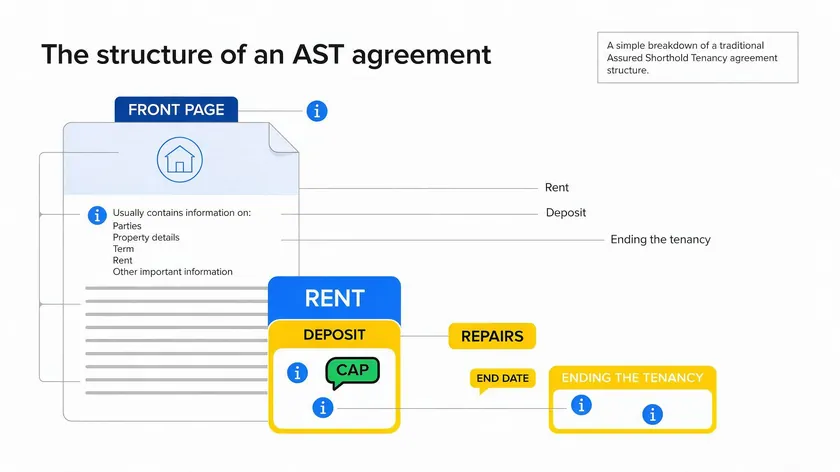
A typical assured shorthold tenancy agreement between 1997 and 2026 was a written contract – often 8–20 pages – combining express terms with implied statutory terms. AST agreements provide a framework that protects both landlords and tenants by clearly setting out mutual rights and responsibilities.
Front-Page Details
- Names and contact details of landlord and tenant – a typical AST sets out contact details of both parties
- The property address – an AST identifies the residential property being rented by address
- Start date, fixed term length (if applicable), rent amount and payment frequency
- Deposit amount and the tenancy deposit scheme used
These front-page details anchor the rest of the agreement and are usually the first thing checked if a dispute arises later
Core Sections of the Agreement
- Rent amount, due date, and any rent review clause for increasing rent
- Deposit and deposit protection obligations
- Repairs and maintenance – AST contracts must detail utility and maintenance responsibilities
- Use of the property, including occupancy limits
- Subletting rules and pet restrictions – the AST outlines restrictions regarding subletting and pets
- Landlord access and inspection rights (usually requiring at least 24 hours’ written notice)
- Ending the tenancy: notice period, break clause terms, and condition on return
Many of the most important rights came not from the printed wording but from the Housing Act 1988, the Housing Act 2004 (deposit protection), the Landlord and Tenant Act 1985, and the Tenant Fees Act 2019. UK tenancy law has been changing and may affect old AST templates – parties should review any agreement against current legislation.
Fixed Term ASTs, Break Clauses and Ending an AST Early
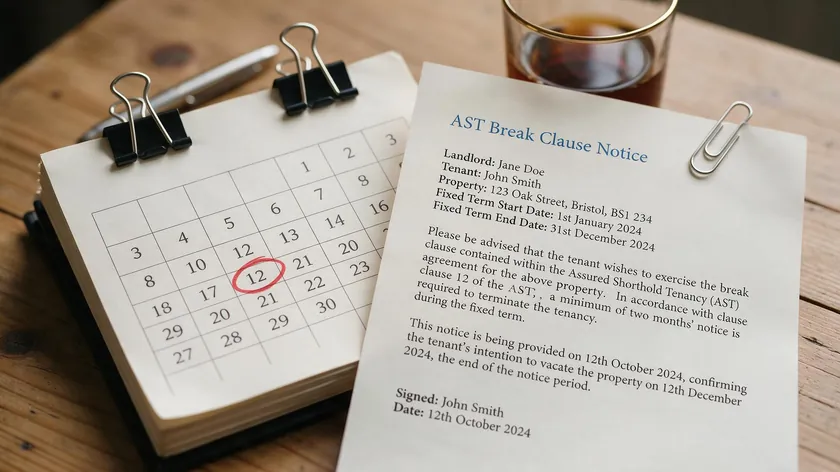
Most assured shorthold tenancy agreements before 2026 were fixed-term ASTs, typically for 6 or 12 months. During this tenancy term, both landlord and tenant were committed for the entire period. A fixed-term AST can only end early with a break clause or a mutual surrender.
How a break clause works: a break clause in an assured shorthold tenancy (AST) specifies an earliest break date (often after 6 months on a 12-month fixed term), requires a minimum notice period (commonly two months), and typically sets conditions such as no unpaid rent or outstanding breaches.
For example, a 12-month fixed-term AST starting on 1 October 2025 with a 6-month break clause would allow early termination from 1 April 2026 onwards, provided two months’ notice was given and all conditions were satisfied.
Surrender is different from a break clause: it requires written agreement from both parties, and the tenant may need to keep paying rent until a new tenant is found within a reasonable time.
To end an AST at the end of the fixed term, the tenant simply moves out on or after the expiry date. For periodic ASTs, give at least one month’s notice.
If neither side takes action and the tenant remains, the tenancy automatically rolls into a statutory periodic tenancy under section 5 of the Housing Act 1988, continuing on the same terms but on a rolling period – usually monthly.
Rent, Increasing Rent and Other Money Terms in an AST Agreement
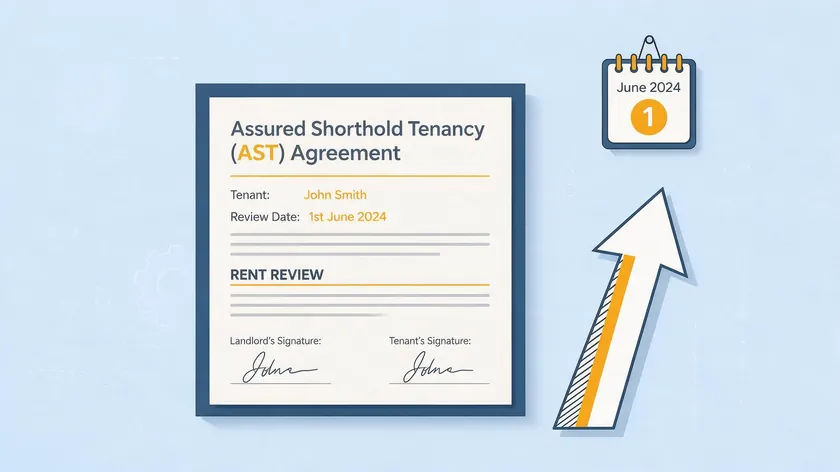
Every assured shorthold tenancy agreement must set out the rent amount clearly, along with the due date, frequency, and method of payment. If there is a mechanism for increasing rent, that must be specified. Rent increases during fixed-term ASTs require agreement or a clause in the contract.
Typical rent review clause mechanisms in ASTs included:
- Fixed annual increases by a set percentage
- Increases linked to the Retail Prices Index (RPI)
- Reviews on renewal of a fixed-term AST at market rent
- For statutory periodic tenancies, landlords used the Housing Act 1988 section 13 process to propose a rent check once a year using a prescribed form, which tenants could challenge at the First-tier Tribunal
Landlords must wait at least six months before increasing rent and must provide at least 28 days’ notice for any proposed increase. Tenants can contest unfair rent increases under ASTs, and tenants can contest excessive rent increases through a tribunal if the proposed amount exceeds market level. For context, average UK rent increased by 4.9% in 2023, making rent review clauses a practical concern.
Other money terms commonly found in AST agreements included holding deposits (capped at one week’s rent under the Tenant Fees Act 2019), late payment interest capped at 3% above the Bank of England base rate, lost key costs, and variation fees capped at £50. Unfair or non-transparent mechanisms for increasing rent, or prohibited fees, risk being unenforceable.
Tenancy Deposit and Deposit Protection in AST Agreements

One of the key requirements for legally compliant AST agreements since April 2007 has been deposit protection. Landlords must protect tenant deposits in a government-approved scheme within 30 days of receiving the money. Deposits must be protected within 30 days of receipt – no exceptions.
The three government-approved schemes in England are:
- Deposit Protection Service (DPS)
- MyDeposits
- Tenancy Deposit Scheme (TDS)
An AST agreement should specify which tenancy deposit scheme is used, or at the very least confirm that an approved scheme will be used and that prescribed information will be served.
Within 30 days, the landlord must also provide tenants with statutory prescribed information: the deposit amount, the scheme name and contact details, how to apply for the deposit back, what deductions can be made, and what to do in case of a dispute. Tenants must receive specific information about the deposit scheme used.
Penalties for non-compliance are significant. Failure to protect a deposit can lead to financial penalties for landlords – courts can order payment of between one and three times the deposit amount. Non-compliance could also historically bar a landlord from serving a valid no-fault eviction notice for as long as the deposit remained unprotected.
Under the Tenant Fees Act 2019, the deposit cap is five weeks’ rent if annual rent is below £50,000, or six weeks’ rent if annual rent is £50,000 or more.
All approved schemes offer an alternative dispute resolution (ADR) process for end-of-tenancy disputes. Approximately 2% of ASTs end in deposit disputes, with decisions typically based on the written agreement, the check-in inventory, and evidence of property damage, cleaning costs, or unpaid rent.
Landlord and Tenant Obligations Under an AST Agreement

An AST agreement combines contractual obligations written into the document with statutory obligations implied by law – some can be negotiated, but many cannot be contracted out of.
Landlord Obligations
- Landlords must conduct a right to rent check before the tenancy begins
- Maintain the property in a good state of repair, including the structure, exterior, and installations for heating and water (Landlord and Tenant Act 1985, section 11) – this is among the landlord’s responsibilities that cannot be waived
- Provide necessary safety certificates, including a gas safety certificate annually
- Provide an energy performance certificate (EPC) on or before move-in
- Fit smoke and carbon monoxide alarms and ensure they meet health and safety standards
- Ensure the property is fit for human habitation
- Protect the deposit and serve prescribed information within 30 days
- Tenants must be provided with a written statement of terms upon request
Most of these duties come from statute rather than the agreement itself, so a landlord cannot contract out of them even if the AST stays silent on the point.
Tenant Obligations
- Paying rent and utilities on time, along with council tax where applicable
- Keeping the property reasonably clean and reporting repairs promptly
- Not causing nuisance or anti-social behaviour
- Not subletting or taking in lodgers without the landlord’s written consent
- Allowing reasonable access for inspections and repairs, provided the landlord gives proper notice (at least 24 hours)
AST agreements often reiterated the statutory right to quiet enjoyment, meaning the landlord cannot interfere with the tenant’s lawful use of the property.
Tenants have the right to live in a safe environment. Breach of these obligations carries consequences: unpaid rent or serious anti-social behaviour could lead to possession claims, while serious disrepair or harassment could give tenants grounds for legal action or compensation.
Dispute Resolution, Possession Notices and Ending Legacy ASTs Now

While the long-term future of ASTs is conversion into assured periodic tenancies, disputes still arise today over deposits, repairs, rent arrears and how an AST can be brought to an end.
- Internal resolution: most AST agreements require parties to try resolving issues directly in writing, sometimes with specified response times, before escalating
- Deposit ADR: deposit scheme alternative dispute resolution is the most common formal path for end-of-tenancy money disputes – decisions are typically based on the AST agreement, the inventory, and evidence of damage or arrears
- Possession notices: historically, a Section 21 notice allowed landlords to regain possession without reason (no-fault eviction), while fault-based grounds under Section 8 covered situations like rent arrears or anti-social behaviour. Landlords must follow the proper legal process – tenants cannot be evicted without a court order after the tenancy ends. Landlords must give at least two months’ notice to regain possession, and tenants cannot be evicted within the first six months of the tenancy
- Statutory eviction process: landlords must follow the legal eviction process to evict tenants. The Renters’ Rights Act 2025 is phasing out the old no-fault route in favour of grounds-based possession for new assured periodic tenancies
For legacy ASTs, the journey to conclusion looks like this: they either finish at the end of a fixed-term AST, are surrendered by verbal agreement or written agreement between both parties, or roll into a statutory periodic tenancy and then, by operation of law, into the new assured periodic tenancy regime – without anyone needing to sign a fresh contract.
How AST Agreements Differ From Other Tenancy Types
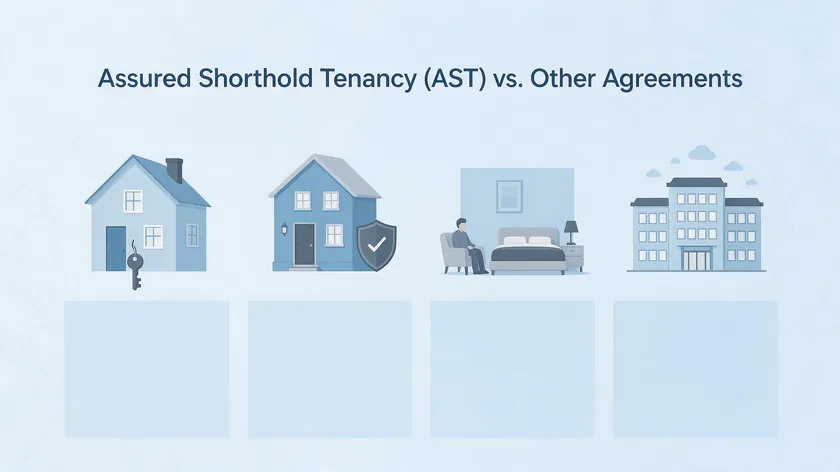
Assured shorthold tenancies sat within a wider ecosystem of housing arrangements. The agreement wording must match the true legal nature of the occupation – calling something an “AST agreement” does not make it one if the statutory conditions are not met.
| Aspect | Assured Shorthold Tenancy (AST) | Assured Tenancy | Licence / Lodger Agreement | Company Let |
|---|---|---|---|---|
| Exclusive possession | Yes – the tenant can exclude everyone, including the landlord. | Yes | No – the landlord usually retains access/control. | Yes, but held by a company, not an individual |
| Statutory protection level | Moderate – historic default under the Housing Act 1988 | High – stronger long-term security, narrower possession grounds | Low – few statutory protections | Low – governed mainly by contract law, not housing statute |
| Deposit protection required | Yes | Yes | Not usually | Not usually |
| Still available for new agreements | No – replaced by assured periodic tenancies from 1 May 2026 | Yes, mostly in a social/housing association context | Yes | Yes |
Correctly classifying the agreement at the outset is critical, because key requirements such as deposit protection, tenant fees rules, and repair obligations vary depending on whether the arrangement is an assured shorthold tenancy, an assured tenancy, a licence, or a company let.
A letting agent or landlord who misclassifies the arrangement risks losing legal rights or facing penalties.
Using Modern Templates for Legacy ASTs and New Tenancies
Although no new AST agreements can be created for private lettings in England after 1 May 2026, landlords and tenants still need clear, written tenancy agreements that respect historic AST terms while aligning with the new regime.
For existing assured shorthold tenancies, if the parties agree to vary clauses – such as updating a break clause, changing rent review wording, or clarifying subletting rules – those variations should be documented in a short written addendum rather than a new agreement labelled as an AST.
When a historic fixed-term AST comes to an end and both parties agree to continue, they now need a tenancy agreement drafted as an assured periodic tenancy, not another fixed-term AST.
Common drafting pitfalls include outdated references to abolished no-fault eviction procedures, prohibited fees, or deposit protection penalties that no longer reflect current law.
Documentify’s tenancy agreement tool guides users through the relevant questions – property type, rent, grounds for possession – to produce a tenancy agreement aligned with current legal requirements, without labelling the output an “AST agreement”.
Key Requirements Checklist for Anyone Still on an AST
This checklist is for landlords and tenants currently living under an existing AST agreement that began before 1 May 2026.
For Landlords
- Deposit protection is correctly in place, and prescribed information was served within 30 days
- Gas safety certificate, EPC, and electrical safety checks (EICR) are all up to date
- A right to rent check was conducted before the tenancy started
- Any rent increases have followed the procedure in the agreement or the statutory process
- Records of inspections, repair requests, and communications are maintained
Landlords who can tick off every item above are well placed to hand over a tenancy that converts smoothly under the new rules.
For Tenants
- You have a copy of the signed assured shorthold tenancy agreement AST
- You understand any break clause and notice period requirements
- Your deposit appears correctly registered with an approved scheme, and you have copies of prescribed information
- You know how to raise repairs or complaints in writing and provide written notice where legally required
Both parties should check how and when their AST will convert into an assured periodic tenancy under the Renters’ Rights Act 2025 – the UK tenancy agreement template guide covers how the new periodic model structures key clauses.
Proactive communication between landlord and tenant two to three months before the end date of any fixed-term AST is strongly encouraged so both sides can agree on the same terms going forward and avoid surprises.
Key Takeaways
- From 1 May 2026, new private lettings in England can no longer start as an assured shorthold tenancy – they must use the new assured periodic tenancy model instead. For full details, see the UK tenancy agreement template guide.
- Existing AST agreements signed before 1 May 2026 remain valid: they run to the end of the fixed term or roll into statutory periodic tenancies before converting by law to assured periodic tenancies.
- The historic key requirements of an assured shorthold tenancy agreement – exclusive possession, market rent, the property as the tenant’s main home, and compliance with statutory exceptions – still matter for legacy ASTs.
- Every legacy AST agreement should contain clear clauses on rent and increasing rent, deposit protection details, break clause wording, repair obligations, and dispute resolution routes such as ADR through tenancy deposit schemes.
- Correctly classifying the agreement type at the outset – whether a short-hold tenancy agreement, assured tenancy, licence, or company let – determines which legal requirements apply to both landlord and tenant.
Whether you’re renewing after an old AST or starting a new tenancy, Documentify’s tenancy agreement tool lets you fill in a document that matches today’s legal requirements in minutes – free to create and preview, with a small fee only when you download the final copy.
FAQ
Can I still get an AST agreement today?
No. From 1 May 2026, private landlords in England can no longer grant new assured shorthold tenancies. The Renters’ Rights Act 2025 requires all new private residential lets to use the assured periodic tenancy structure instead.
Existing AST agreements that started before 1 May 2026 remain valid – they continue as fixed-term or periodic ASTs until they naturally convert by law into assured periodic tenancies, without needing a new contract.
If you are moving into a property now, expect to sign an assured periodic tenancy agreement. The UK tenancy agreement template guide explains how that modern agreement works.
What happens to my fixed-term AST when it expires now?
For fixed-term ASTs that began before 1 May 2026, the traditional rule still applies: if neither side signs a new agreement and the tenant stays, the tenancy automatically becomes a statutory periodic tenancy on the same terms, with rent paid monthly or weekly as before. Under the Renters’ Rights Act 2025, those statutory periodic ASTs then convert by operation of law into the new assured periodic tenancy model.
Both landlord and tenant should review the agreement roughly three months before the fixed term end date to decide whether to leave, negotiate new terms, or continue on a periodic basis.
Does deposit protection still matter if my AST is converting?
Absolutely. Deposit protection continues to be legally required for as long as any deposit is held, regardless of whether the tenancy is labelled an AST or has converted to an assured periodic tenancy.
Failing to have correctly protected a deposit – even back when the AST began – can still lead to financial penalties of one to three times the deposit amount and may restrict a landlord’s ability to regain possession. Tenants should confirm their deposit is registered with an approved scheme and keep copies of all prescribed information.
Can my landlord still increase the rent under an old AST?
Yes, but only by following the mechanism in the original shorthold tenancy agreement (such as a valid rent review clause) or the applicable statutory procedure for periodic tenancies.
For many statutory periodic tenancies that began as ASTs, the landlord must use the appropriate statutory notice form and give proper notice, and tenants can contest unfair rent increases under the Housing Act through a first-tier tribunal.
Always read the “increasing rent” section of your agreement carefully and seek advice before agreeing in writing to any change.
What if my agreement calls itself an AST but started after 1 May 2026?
The legal classification of a tenancy depends on statute, not on the document label. If a private residential letting in England began after 1 May 2026, it is treated as an assured periodic tenancy even if the contract still says “assured shorthold tenancy agreement”.
Such an agreement should be reviewed and updated to reflect the correct tenancy type and current legal requirements – particularly around possession grounds and notice periods.
Landlords in this situation should use an up-to-date tenancy agreement tool, such as Documentify’s, to generate a legally compliant assured periodic tenancy agreement and replace or supplement the outdated wording.

