
This page is a practical outline for building or checking an assured periodic tenancy agreement template in England after the Renters’ Rights Act 2025 took effect on 1 May 2026.
The focus here is on what needs to sit inside a compliant periodic tenancy agreement – not on general tenancy law basics, which are covered in broader tenancy agreement template guidance elsewhere.
The outline assumes a standard landlord–tenant letting of a whole dwelling in England – not lodgers, commercial premises, or holiday lets. Scotland, Wales and Northern Ireland each use different tenancy regimes and are only touched on briefly later in this article.
Table of Contents
- Assured periodic tenancies after 1 May 2026 – the legal context
- Assured periodic tenancy vs. old AST templates – structural differences
- Core elements of an assured periodic tenancy agreement template
- Mandatory written statement of terms for assured periodic tenancies
- Rent, deposits and financial clauses in a periodic tenancy agreement
- Repairing duties, safety obligations and access rights
- New rules on pets, discrimination and fair letting practices
- Existing tenancies, conversion and updating your paperwork
- Jurisdiction checks – when this template is not suitable
- Key Takeaways
- FAQ
- How can I tell if a template is genuinely an assured periodic tenancy and not just a rebadged AST?
- Can I agree to a minimum stay period in an assured periodic tenancy?
- Do I need a new assured periodic tenancy agreement when I increase the rent?
- How should guarantor clauses work in an assured periodic tenancy?
- Can I use the same assured periodic tenancy template for a joint tenancy with multiple tenants?
Assured periodic tenancies after 1 May 2026 – the legal context
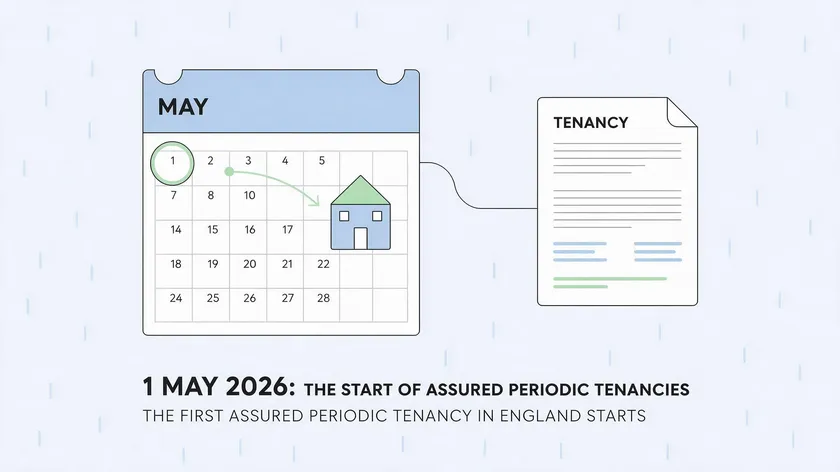
The Renters’ Rights Act 2025 received Royal Assent on 27 October 2025, and its first stage came into force on 1 May 2026. From that date, assured periodic tenancies became the default form of tenancy in England’s private rented sector.
The updated Assured Tenancies (Private Rented Sector) (Written Statement etc. and Information Sheet) Regulations 2026 (SI 2026/324) also kicked in, creating a new statutory duty for landlords to provide certain information to tenants.
An assured periodic tenancy – sometimes shortened to APT – is a rolling tenancy with no fixed end date, usually running on a monthly basis, that meets the criteria under the Housing Act 1988 as modified by the 2025 Act. Assured shorthold tenancies were abolished on 1 May 2026, and all new tenancies created from that date are assured periodic tenancies.
Section 21 “no fault” evictions are no longer allowed; landlords must instead rely on updated possession grounds under Section 8. Existing assured shorthold tenancies convert to assured periodic tenancies automatically. For a historical comparison of how the old AST structure worked, see the AST Agreement Guide.
Any periodic tenancy agreement template used from May 2026 must reflect these new rules or risk containing clauses that are unenforceable, void, or that expose landlords to penalties of up to £7,000.
Assured periodic tenancy vs. old AST templates – structural differences
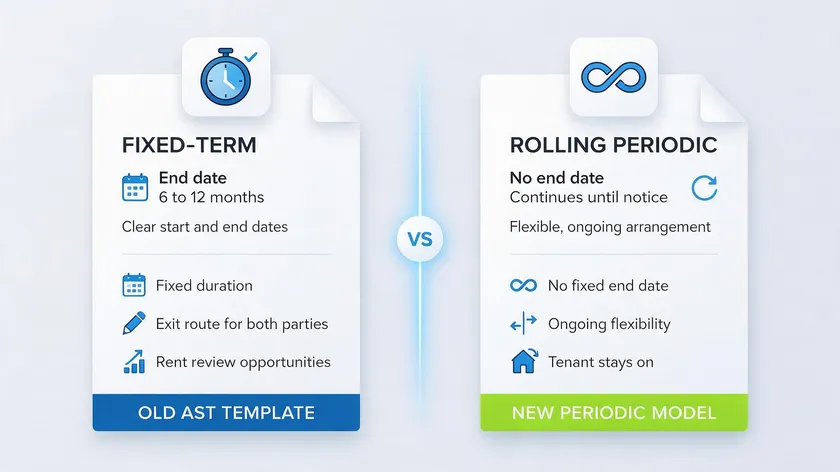
Many landlords across England – whether in London or elsewhere – still hold 2023–2025 AST templates. These documents cannot simply be re-badged as “assured periodic” and used after May 2026. The structural differences between the old and new regimes run deep.
| Feature | Typical AST (pre-May 2026) | Compliant APT (post-May 2026) |
|---|---|---|
| Fixed term | Common – 6 or 12 months with break clauses | Not allowed – tenancy is periodic from day one. |
| Section 21 eviction | Available as a no-fault route | Abolished – possession must follow statutory grounds |
| Rent period | Could be quarterly or annual | Must be monthly or no more than 28 days |
| Rent in advance | Often several months requested upfront | Maximum one month’s rent in advance after the agreement is signed |
| Written statement of terms | Only on tenant request, limited scope | Mandatory for all assured tenancies, with prescribed content |
| Rent bidding | Unregulated in most templates | Banned – advertised rent is binding |
Any clause purporting to grant a 6- or 12-month fixed term in an assured tenancy after 1 May 2026 is of no legal effect – a clear red flag that the template is outdated. Similarly, references to “no-fault eviction”, “initial fixed term”, or “break clause at month 6” all signal a legacy document that needs replacing, not just renaming.
Understanding these structural changes is the first step before editing or choosing an assured periodic tenancy agreement template.
Core elements of an assured periodic tenancy agreement template

Every assured periodic tenancy agreement in England should contain the following building blocks. Rental agreements must include parties’ names, property details, and rent payment terms – but the list goes further than that.
- Parties and property description – full names of landlord and tenant, the property address, and a clear statement that this is an assured periodic tenancy.
- Start date and rental period – the date the tenancy begins, confirmation the contract is periodic, and the frequency of rent periods (e.g., monthly periodic tenancies).
- Rent amount and payment – how much rent is payable, on what date, and by what method.
- Deposit and prescribed information – the deposit amount, the protection scheme used, and the timeline for serving prescribed details.
- Repairs and safety – the landlord’s statutory obligations and the tenant’s duty to report disrepair.
- Tenant obligations – paying rent, keeping the property clean, avoiding nuisance.
- Landlord obligations – maintaining the dwelling, providing safety certificates, complying with regulations.
- Access and inspections – the landlord’s right to enter with notice, contact details, and service addresses.
- Policies on pets and alterations – the tenant’s right to request permission and the process for granting or refusing it.
- Ending the tenancy and notices – how either party serves valid notice, including that tenants can give two months’ notice to end the tenancy.
Later sections below zoom in on the mandatory written statement, updated clauses on rent and deposits, and new rules on pets and discrimination that apply from May 2026.
Mandatory written statement of terms for assured periodic tenancies

From 1 May 2026, landlords in England must give tenants a detailed written statement for all new assured tenancies. Landlords must provide a written statement before the tenancy starts – or at the very latest, before the tenancy agreement is signed. Templates must include mandatory Renters’ Rights Act clauses. The document – or an attached schedule – must capture the following:
- Full names and addresses for service of all parties.
- The property address.
- Rent amount, due date, and rental period.
- Rent review mechanism – the template should refer to the statutory Section 13 process; the dedicated article on rent increase notice covers the full procedure, including Form 4A.
- Which utilities and council tax are included in the rent.
- Deposit amount, the name of the tenancy deposit scheme, and the deadline for protection.
- Repair responsibilities and safety certificate obligations (gas, electrical, smoke and CO alarms).
- Any other prescribed information required by SI 2026/324 and the regulations.
Landlords should deliver this written statement at or before the tenancy start date and update it within a specified timeframe – typically 28 days – if certain terms change.
A well-drafted assured periodic tenancy agreement template should clearly label this section (for example, “Section A – Mandatory Information”) so compliance can be checked at a glance.
Failing to include these mandatory statements can lead to enforcement action, fines, and tribunal disputes that complicate any future possession claim.
Rent, deposits and financial clauses in a periodic tenancy agreement

Assured periodic tenancies sit on rolling rental periods – commonly monthly – and financial clauses must comply with the new rules from May 2026.
The Tenant Fees Act controls what payments landlords can request from tenants, and getting these details wrong is one of the main reasons agreements are challenged.
Rent
- The template must state the exact rent amount, whether it is payable weekly or monthly, and confirm the rental period does not exceed one month (or 28 days).
- For new tenancies from 1 May 2026, a landlord cannot require rent before the agreement is signed. After signing, a maximum of one month’s rent in advance may be collected.
- Rent bidding above the advertised price is banned – the agreement should reflect the open market rent that was advertised.
- Rent increases require a Section 13 notice with two months’ notice under the statutory process. The template’s rent review clause should signpost this rather than create a conflicting contractual mechanism. A proposal for a rent increase follows the statutory route, not a private contract term.
- Landlords must serve the appropriate statutory notices for possession or rent increases.
These rent clauses sit alongside the deposit rules below, which apply the same May 2026 limits on landlords.
Deposits
- Where the annual rent is below £50,000, the deposit cap is five weeks’ rent. For annual rent between £50,000 and £100,000, the cap rises to six weeks’ rent.
- Deposits must be protected in an authorised tenancy deposit scheme within 30 days of receipt, and prescribed information about the scheme must be served on the tenant.
- The template should set out the circumstances under which lawful deductions may be made – unpaid rent, damage beyond fair wear, and cleaning costs.
- Use precise placeholders: amount, due date, bank details, scheme name. Ambiguity here invites challenge.
Unclear or non-compliant financial clauses remain one of the most common reasons assured periodic tenancy agreements end up before a court or tribunal.
Repairing duties, safety obligations and access rights

Because assured periodic tenancies run indefinitely with no fixed term, well-drafted repair and access clauses are essential for long-term compliance. The landlord must ensure properties meet repair standards and comply with safety regulations throughout the life of the tenancy.
The template should cover the landlord’s statutory repairing obligations – structure, exterior, heating, hot water and sanitation – alongside the tenant’s duty to keep the property reasonably clean and to report disrepair promptly.
Gas safety certificates must be renewed annually. Electrical installation inspections follow a regular cycle. Smoke alarms and carbon monoxide alarms must be fitted and maintained. For HMOs, fire safety in common parts must also be addressed.
Access for inspections and works should require at least 24 hours’ written notice from the landlord, except in genuine emergencies. Any service charge or maintenance contributions should be clearly described and compatible with an assured tenancy framework.
Including clear safety and access clauses helps demonstrate due diligence if disputes eventually reach the tribunal and supports any proceedings a landlord may need to bring.
New rules on pets, discrimination and fair letting practices

The Renters’ Rights Act 2025 introduced specific tenant-facing rights that must now be reflected in assured periodic tenancy agreement templates. Pre-2026 documents are most likely to need updates in exactly these areas.
Pets
Tenants can request permission to keep pets, which landlords cannot unreasonably refuse. The template should include a clause recognising the tenant’s contractual right to make such a request.
Landlords must respond in writing – for example, within 28 days – stating whether the request is approved or refused. Any refusal must be on reasonable grounds. If permission is granted, conditions such as extra cleaning at the end of the tenancy should be recorded in the agreement.
Discrimination and fair letting practices
Blanket “no benefits” or “no children” policies are not permitted. The template’s wording – and any accompanying offer letters or application documents – must avoid discriminatory language.
Landlords may still carry out referencing and affordability checks, but these must comply with equality law. Rent bidding is banned, and the tenancy agreement must match the advertised rent.
Aligning the template with these new rules protects both parties from avoidable legal risk and keeps the document valid if scrutinised later.
Existing tenancies, conversion and updating your paperwork
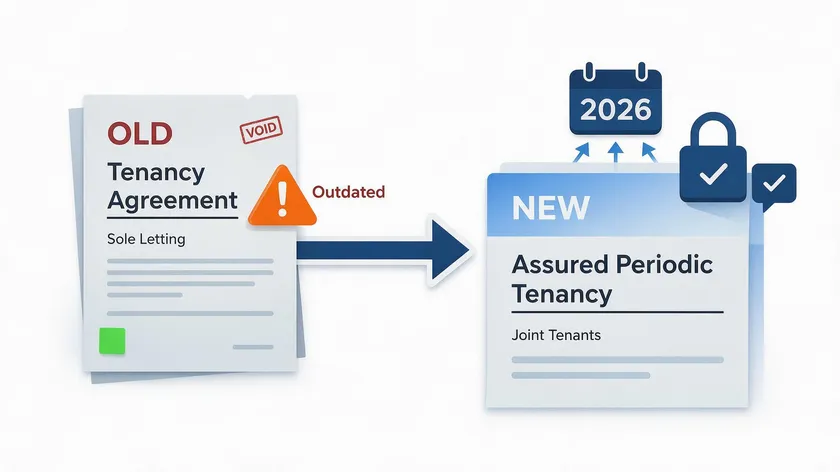
On 1 May 2026, most existing ASTs and other qualifying assured tenancies automatically became assured periodic tenancies – even where the written agreement still shows a fixed-term end date.
Fixed-term tenancies with dates on or after 1 May simply continue as periodic. The transition happened by operation of law, not by signing a new contract.
- Landlords are not required to sign a brand-new agreement for existing tenancies but must provide the prescribed Information Sheet by 31 May 2026. Failing to do so risks penalties up to £7,000.
- Fixed terms in existing assured tenancies effectively ceased to apply after conversion.
- Unwritten or very basic existing tenancies need a more complete written statement of key terms by 31 May 2026.
- Landlords should consider moving tenants onto an updated assured periodic tenancy agreement template at renewal or variation to avoid confusion caused by obsolete AST language.
- Where both parties agree to end and replace an existing tenancy with a new agreement, the process for a surrender of tenancy is covered separately elsewhere.
While the law converted existing tenancies automatically, tidy paperwork still matters. If a dispute arises – whether over notice periods, how much rent is owed, or a possession claim – a clear, up-to-date document carries far more weight than a patched-up legacy contract.
Jurisdiction checks – when this template is not suitable
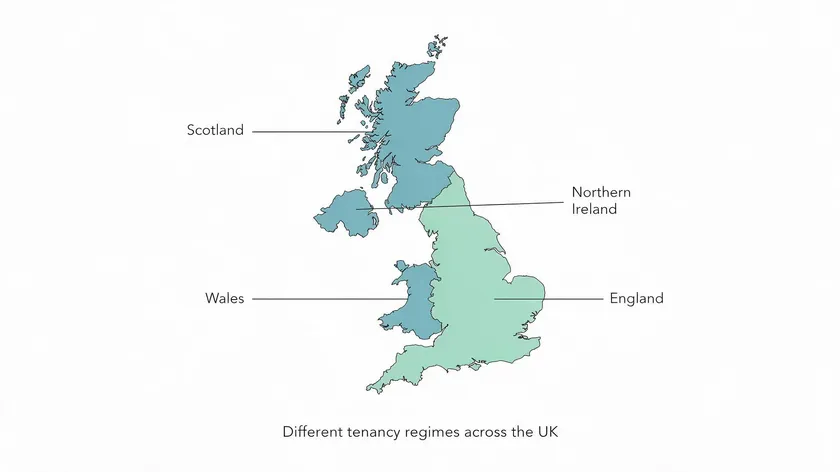
Assured periodic tenancies are an England-only concept under the Housing Act 1988 and Renters’ Rights Act 2025. This template is not suitable for privately rented properties outside England.
- Scotland uses Private Residential Tenancies under a separate regime – the Tenancy Agreement Scotland guide covers that system.
- Wales uses standard occupation contracts under the Renting Homes (Wales) Act 2016.
- Northern Ireland has its own legislation governing most private tenancies.
- Resident landlords letting a room to a lodger typically create a licence, not an assured tenancy.
- Holiday lets, purpose-built student accommodation, and genuine licences may also fall outside the assured tenancy framework.
Landlords who are unsure whether their letting qualifies should take guidance or use a jurisdiction-specific template. Always double-check the property’s location and setup before relying on any “assured periodic” label on a document.
Using the wrong template for the wrong jurisdiction can invalidate key clauses and complicate any future possession proceedings.
Key Takeaways
- From 1 May 2026, most privately rented homes in England must use assured periodic tenancies – landlords cannot offer fixed terms for assured periodic tenancies.
- A compliant assured periodic tenancy agreement template must contain a government-mandated written statement of terms, plus robust clauses on rent, deposits, repairs, pets and notice.
- Simply renaming an old assured shorthold tenancy template is not enough – clauses referencing fixed terms, Section 21, or quarterly rent in advance must be removed or rewritten.
- Existing tenancies granted before May 2026 convert automatically, but landlords should still update their paperwork and deliver the prescribed Information Sheet by 31 May 2026.
- Assured periodic tenancies have no fixed end date and run on a rolling basis – tenants can serve two months’ notice to end assured periodic tenancies at any time.
Documentify’s tenancy agreement generator lets you create and preview a document for free, though its output is still labelled an “Assured Shorthold Tenancy Agreement” – check it against the requirements above first. Downloading has a small fee and doesn’t guarantee full compliance without manual review.
FAQ
These questions cover edge cases and practical points not fully addressed in the main body of this article.
How can I tell if a template is genuinely an assured periodic tenancy and not just a rebadged AST?
A compliant template will have no fixed term end date, will avoid the phrase “assured shorthold tenancy”, and will not reference Section 21 notices anywhere. It should limit rent in advance to one month’s rent for new tenancies and include a clearly labelled written statement of terms with all the prescribed content from the 2026 Regulations.
If the document still refers to an “initial fixed term”, “no-fault eviction”, or rent being paid quarterly in advance, it is almost certainly a pre-2026 AST template that has not been properly updated.
Can I agree to a minimum stay period in an assured periodic tenancy?
Landlords and tenants can discuss expectations informally – for example, hoping for at least 12 months’ occupation – but the law from May 2026 does not allow a binding fixed term for assured periodic tenancies. Any clause that tries to lock a tenant in for a set period is of no legal effect.
Tenants retain the right to give their statutory notice – typically two months – at any time after the tenancy begins. Clauses trying to impose penalties for leaving “early” may be ruled unenforceable or unfair under consumer protection rules.
Do I need a new assured periodic tenancy agreement when I increase the rent?
No. A rent increase in a periodic assured tenancy is normally handled through the statutory Section 13 notice process, not by creating a brand-new tenancy agreement.
The landlord issues a formal proposal on the correct form, and the tenant can accept or refer the matter to the tribunal.
Make sure the original template’s rent review clause is compatible with that statutory process. The dedicated article on how much notice for a rent increase in England in 2026 covers the full timeline and forms.
How should guarantor clauses work in an assured periodic tenancy?
The template should include a separate guarantor deed – signed as a deed, not merely as a contract – that clearly states the guarantor is liable for rent and other tenant obligations for as long as the periodic tenancy continues, including any lawful variations.
The document should specify whether the guarantee covers future rent increases and how the guarantor can request copies of key notices.
Can I use the same assured periodic tenancy template for a joint tenancy with multiple tenants?
Yes. One assured periodic tenancy agreement can cover multiple tenants on a joint and several basis, meaning each tenant is responsible for all the rent and obligations – not just their share.
The template should clearly name all tenants, capture their individual contact details, and explain how notice works when one joint tenant wishes to leave.
In a periodic tenancy, a valid notice to quit from one joint tenant can end the whole tenancy for all parties, so the agreement should sign-post this clearly.

